Balmukund concast ltd was established as a Limited company in 1995 by the Family Members of Late Sri Gopal Krishna Kanodia, the doyen of the steel industry of eastern India and having its Registered Office at Hungerford street, kolkata-17.
Balmukund concast ltd was established as a Limited company in 1995 by the Family Members of Late Sri Gopal Krishna Kanodia, the doyen of the steel industry of eastern India and having its Registered Office at Hungerford street, kolkata-17.

In today’s era of globalization, various industries have witnessed a remarkable surge in technological advancements and innovation, which play a crucial role in driving economic growth. In this highly competitive business environment, the effective adoption and management of cutting-edge technology have become key indicators of a company’s success.
The effective utilization of technology plays a crucial role in enhancing business competitiveness—no longer a choice, but a necessity in today’s dynamic market. At BCL, we recognize this need and take pride in being a trusted manufacturer of TMT bars ranging from 6mm to 32mm in India.
Our products are manufactured through a unique, fully integrated process that incorporates advanced techniques and stringent quality checks at every stage of production. The result is TMT bars that offer an exceptional combination of strength, ductility, and superior weldability—delivering what we proudly call the “Strength of Truth.”
Balmukund TMT Bars has always prioritized uncompromising quality. Our commitment to superior standards ensures durable, reliable, and highly marketable products for every construction need. From production planning to the final stage, our TMT bar manufacturing process integrates quality at every step, following strict protocols to continuously enhance value and performance.
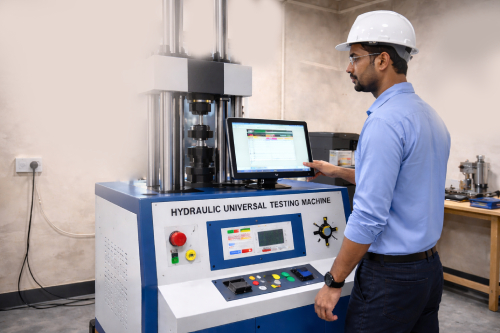
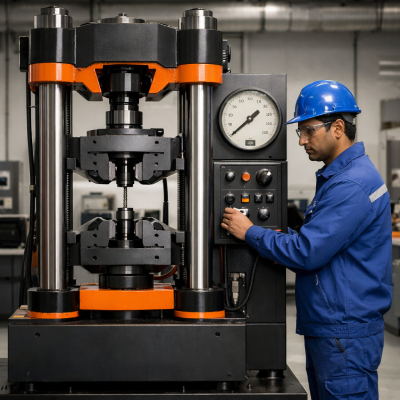
Our state-of-the-art quality control laboratory is equipped with advanced tools including 100KV Universal Testing Machine, Spectrometer, Hardness Testing Machine, Microscope, and other precision instruments. These tools ensure continuous monitoring and improvement of TMT bars at every stage of production.
Being TUV certified, Balmukund TMT Bars strictly adhere to international quality standards, providing reliable assistance in improving and maintaining superior quality across TMT Bars, Billets, and Structural Steel.
The entire Quality Management passes through four levels:
Purpose: To conduct inspection, testing, identification, and traceability of materials and products at various stages of production, ensuring compliance with IS standards and customer requirements.
Scope: This process includes inspection, testing, identification, and traceability from raw material receipt to in-process checks and final inspection before dispatch.
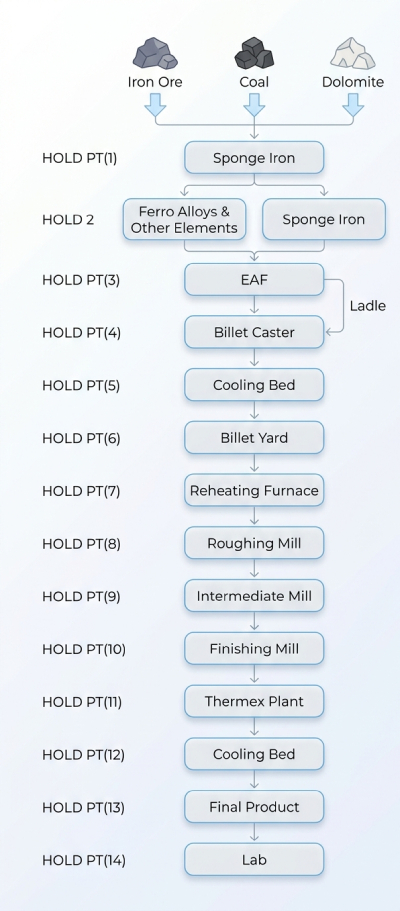
| S.No. | Activity |
|---|---|
| 1 | Chemical analysis of iron ore, coal, dolomite |
| 2 | Final chemical analysis of sponge iron |
| 3 | Chemical analysis of sponge iron, ferro alloys & other elements |
| 4 | Refining and deslagging |
| 5 | Chemical analysis and visual inspection of billets |
| 6 | Final chemical analysis of billets |
| 7 | Re-heating furnace temperature check |
| 8 | Splitting tendency check |
| 9a | Incoming material temperature check |
| 9b | Water temperature and pressure check |
| 9c | Outgoing material temperature check |
| 9d | Equalising temperature check |
| 10 | Final physical and chemical analysis of finished product |
The next level quality assurance includes inspection, correction, and investigation to identify root causes and implement actions to prevent recurring errors.
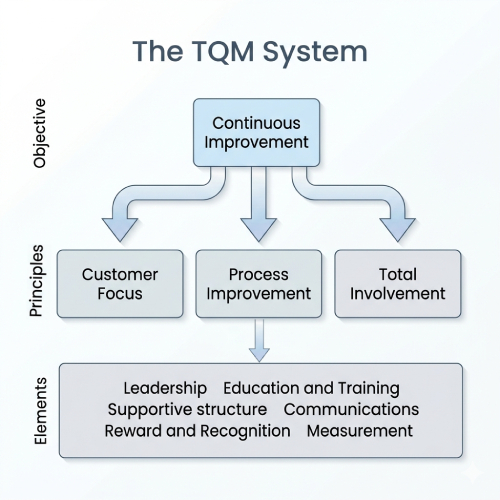
Total Quality Management (TQM) is a comprehensive approach designed to achieve manufacturing excellence by integrating quality into every aspect of operations.
TQM is the systematic approach of managing the entire organization to consistently achieve excellence and long-term success.
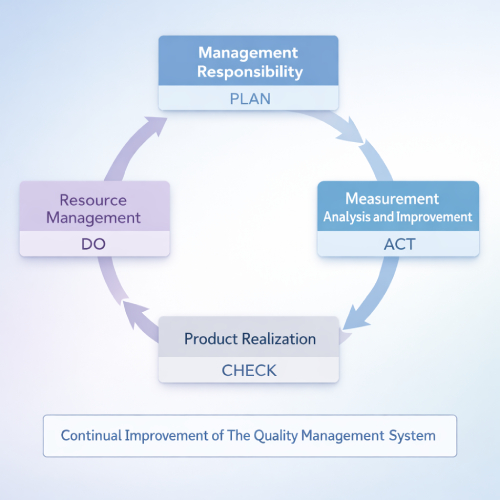
The PDCA cycle is a systematic approach used to ensure continuous improvement in processes and product quality.