Balmukund concast ltd was established as a Limited company in 1995 by the Family Members of Late Sri Gopal Krishna Kanodia, the doyen of the steel industry of eastern India and having its Registered Office at Hungerford street, kolkata-17.
Balmukund concast ltd was established as a Limited company in 1995 by the Family Members of Late Sri Gopal Krishna Kanodia, the doyen of the steel industry of eastern India and having its Registered Office at Hungerford street, kolkata-17.

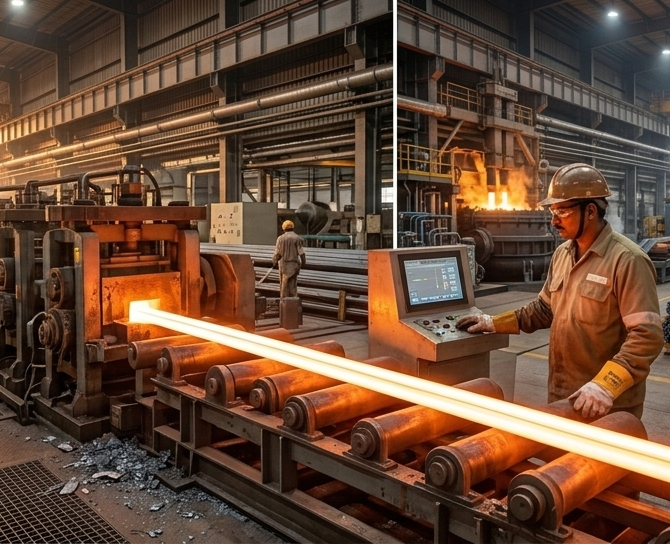
Balmukund TMT is known for delivering best-in-class steel solutions with advanced manufacturing standards. Our integrated steel plants are equipped with state-of-the-art technology, including DRI Units, Electric Arc Furnaces (EAF), Continuous Billet Casting Mills, and high-speed Rolling Mills.
With microprocessor-based production systems and fully equipped Quality Assurance & Testing laboratories, we ensure every TMT bar meets the highest standards of strength, durability, and performance.
Our premium quality TMT bars are highly preferred for all types of construction projects across India, offering superior bonding, corrosion resistance, and long-lasting structural integrity.
Advanced Sponge Iron Manufacturing Process
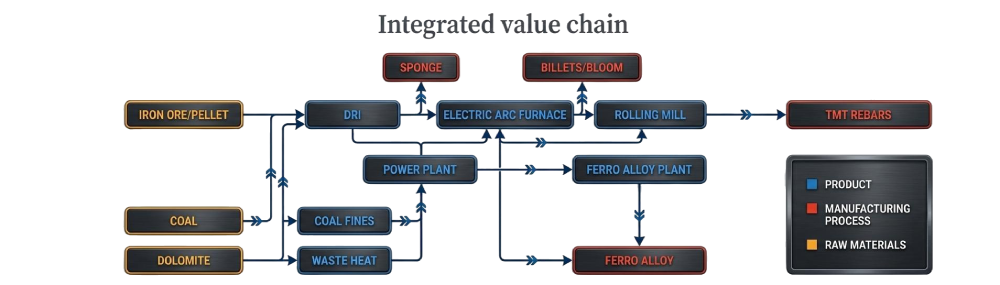
Balmukund TMT operates advanced Direct Reduced Iron (DRI) units as part of its integrated steel manufacturing process. In the DRI plant, sponge iron is produced by reducing iron ore (lumps or pellets) using a carbon-based reductant such as coal.
The reduction process takes place inside a rotary kiln, which is slightly inclined and rotates at controlled speeds. The kiln operates at a high temperature range of 850°C to 1050°C, ensuring efficient chemical reduction of iron ore.
Due to the inclination and continuous rotation of the kiln, raw materials gradually move from the feed end to the discharge end. During this movement, iron ore undergoes reduction and is converted into metallic iron (sponge iron).
The discharged material is then passed through a rotary cooler, where it is cooled before separating sponge iron from coal char, ensuring high purity and quality output.
Advanced Steel Melting, Refining & Purification Technology
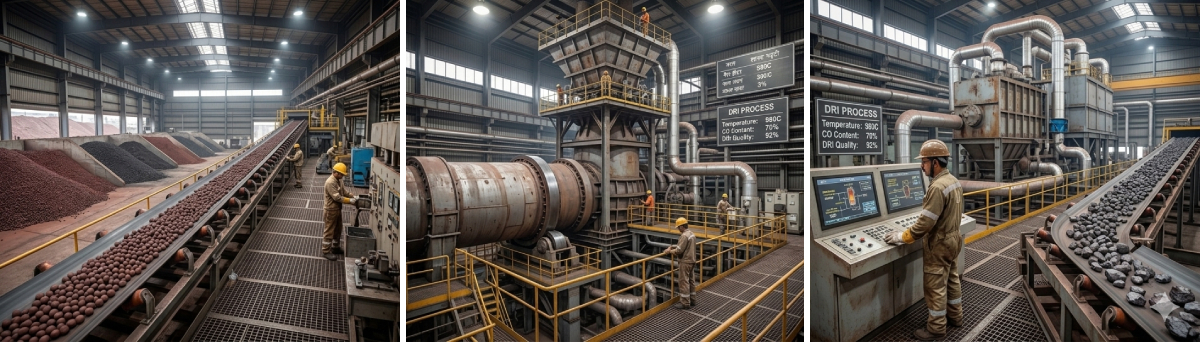
Balmukund TMT utilizes advanced Electric Arc Furnace (EAF) technology to manufacture high-quality steel with superior strength and durability. This process ensures precise control over temperature, chemical composition, and impurity removal, making it one of the most efficient and reliable steelmaking methods.
The Electric Arc Furnace operates by generating intense heat through electric arcs formed between graphite electrodes and the charged material. This high-temperature environment allows rapid melting and refining of steel, ensuring consistent quality and performance.
The process begins with the preparation of raw materials based on the required grade of steel. Sponge iron, scrap steel, and other alloying elements are carefully measured and charged into the furnace along with lime in a precise ratio.
Proper charging ensures the desired chemical composition and helps in achieving optimal melting efficiency and product quality.
Melting is carried out by supplying electrical energy through graphite electrodes, generating arcs that produce extremely high temperatures of around 1800°C. This intense heat melts the charged materials rapidly.
Carbon reacts with oxygen to form carbon monoxide (CO), which creates a foamy slag layer. This slag plays a crucial role in protecting molten steel and absorbing impurities.
During this stage, oxidation reactions remove unwanted elements such as silicon, manganese, phosphorus, and sulphur, improving steel purity.
Refining is the process of removing undesirable elements and adjusting the chemical composition of steel. Elements like sulphur and phosphorus are effectively reduced, while carbon content is controlled to meet required specifications.
Aluminum, silicon, and manganese react with oxygen to form oxides, which are absorbed into the slag. The generation of CO bubbles enhances mixing, improving overall metallurgical reactions.
This stage also helps reduce nitrogen and hydrogen levels, ensuring better ductility and strength of the final product.
De-slagging is a critical step where the slag layer formed above molten steel is removed to eliminate impurities. The furnace is tilted towards the slag door to discharge the slag safely.
Phosphorus is removed at an early stage and transferred to slag as P₂O₅, preventing it from re-entering the metal. Multiple de-slagging operations may be carried out during refining to ensure maximum purity.
This process ensures clean, high-quality molten steel ready for further processing.
With advanced Electric Arc Furnace technology, Balmukund TMT ensures the production of high-quality steel that meets international standards. The controlled process results in superior strength, durability, and consistency, making it ideal for modern construction and infrastructure projects.
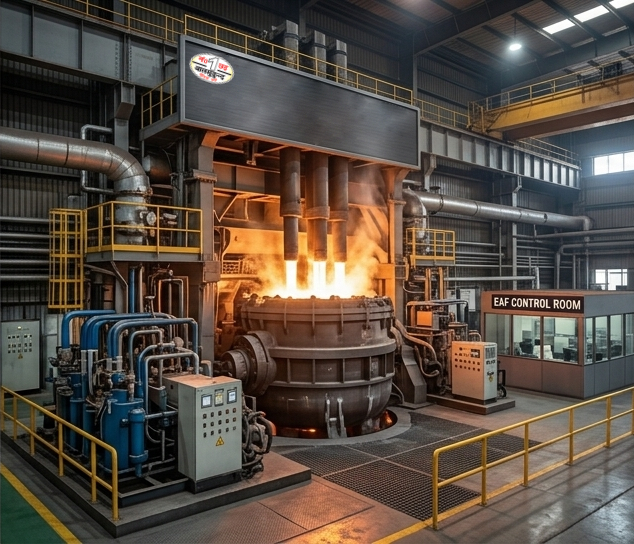
After achieving the required temperature and desired chemical composition, Balmukund TMT initiates the tapping process. The tap hole of the Electric Arc Furnace is opened, allowing the molten steel to flow into a ladle for further processing.
During tapping, bulk alloys are carefully added based on bath analysis to achieve the precise steel grade. This ensures that the final product meets strict quality and performance standards required for construction applications.
De-oxidation is an essential step carried out to control the oxygen content in molten steel. This process, commonly known as "killing of steel", is performed by adding elements such as aluminum, silicon, ferrosilicon, or silicon manganese.
Proper de-oxidation improves the structural integrity, strength, and overall quality of steel, making it suitable for high-performance applications.
Once tapping and alloying are complete, the molten steel is transferred to the continuous casting unit, where it is cast into billets for further rolling and shaping into TMT bars.
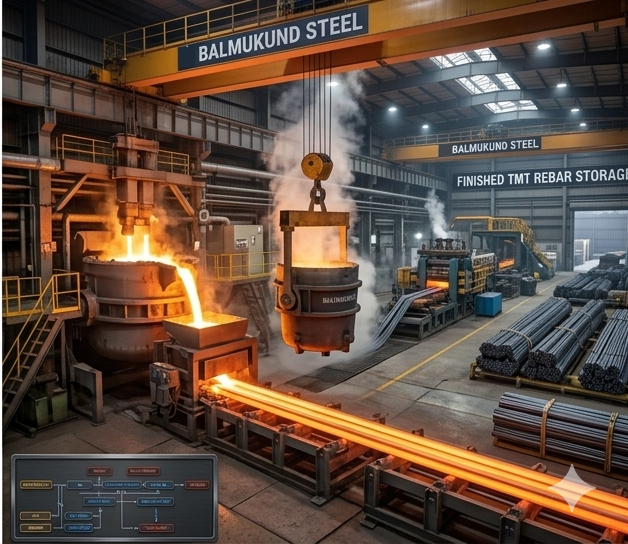
Advanced Reheating, Rolling & Controlled Cooling Technology
Balmukund TMT utilizes advanced rolling mill technology to convert billets into high-quality TMT bars with superior strength, durability, and flexibility. The process ensures precise control over temperature and mechanical properties to meet modern construction standards.
The billets are reheated in a re-heating furnace at approximately 1200°C and then passed through a series of rolling stands to achieve the desired size and shape of finished TMT bars.
After leaving the final rolling stand, the hot TMT bars are passed through a specially designed cooling system where they are rapidly cooled using controlled water flow.
This process hardens the outer surface of the bars, forming a strong outer layer while the inner core remains hot and ductile. This controlled cooling ensures optimal strength and performance.
Once the bars exit the cooling system, the heat from the core flows toward the surface. This natural heat transfer tempers the hardened outer layer, creating a balanced structure with both strength and flexibility.
This stage enhances toughness and improves resistance to stress and fatigue.
The bars are then laid on a cooling bed where they cool naturally at room temperature. During this stage, the internal structure transforms into a ductile and stable form.
The final structure consists of a strong outer layer and a soft, ductile core, ensuring high tensile strength, excellent bendability, and superior weldability.
With advanced rolling mill processes, Balmukund TMT ensures the production of high-performance TMT bars that offer exceptional strength, durability, and safety for all types of construction projects.